

Compressed Air Piping Installation in Virginia: How the Process Works, Step by Step
From the site walk-through to the pressure test, here is what a Class A Virginia contractor does and what to ask.
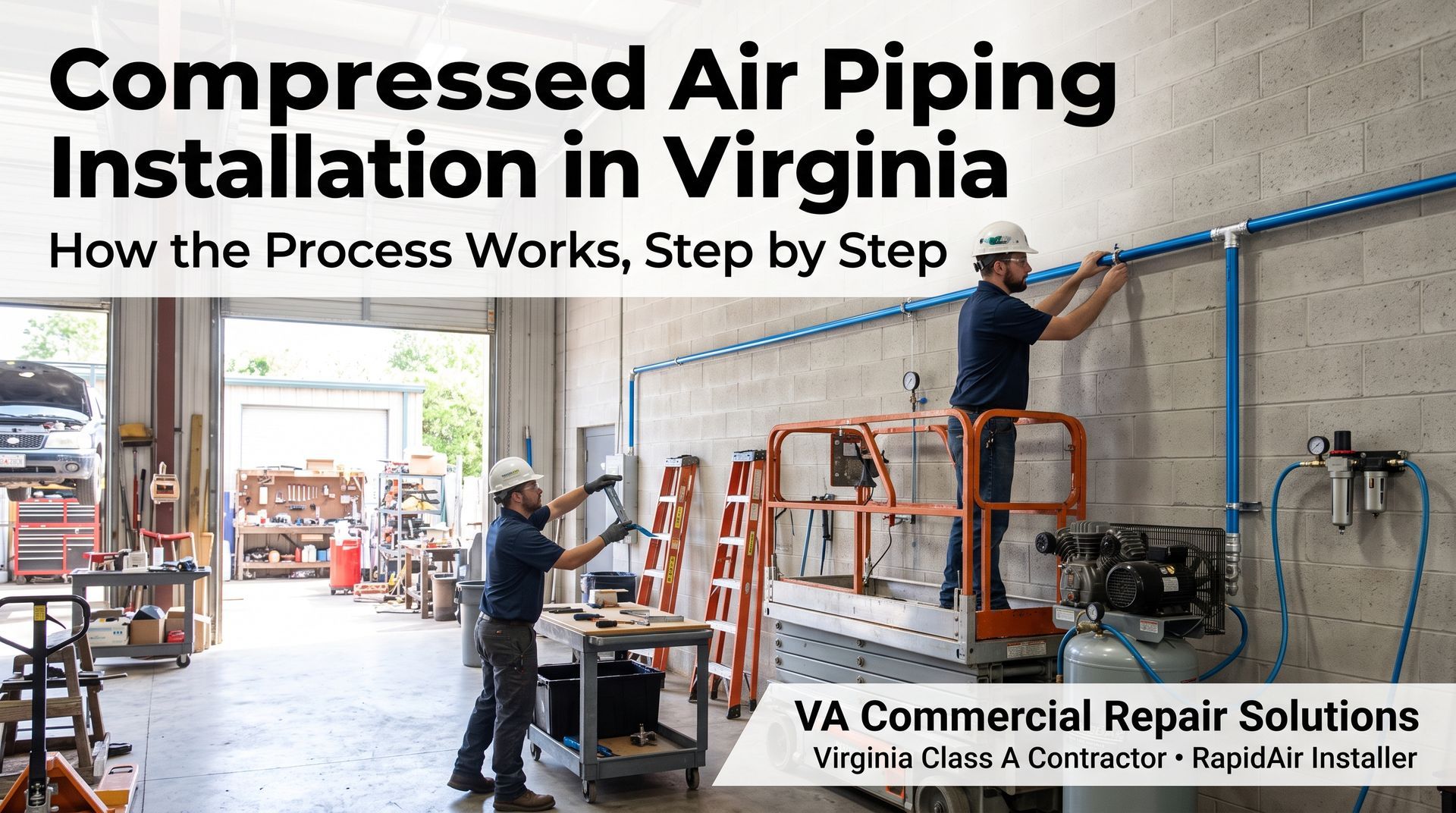
VA Commercial Repair Solutions is a Class A mechanical contractor in Fishersville, Virginia. We are the local RapidAir factory representative and installer, and we design every compressed air piping system in house for shops and facilities across Central Virginia.
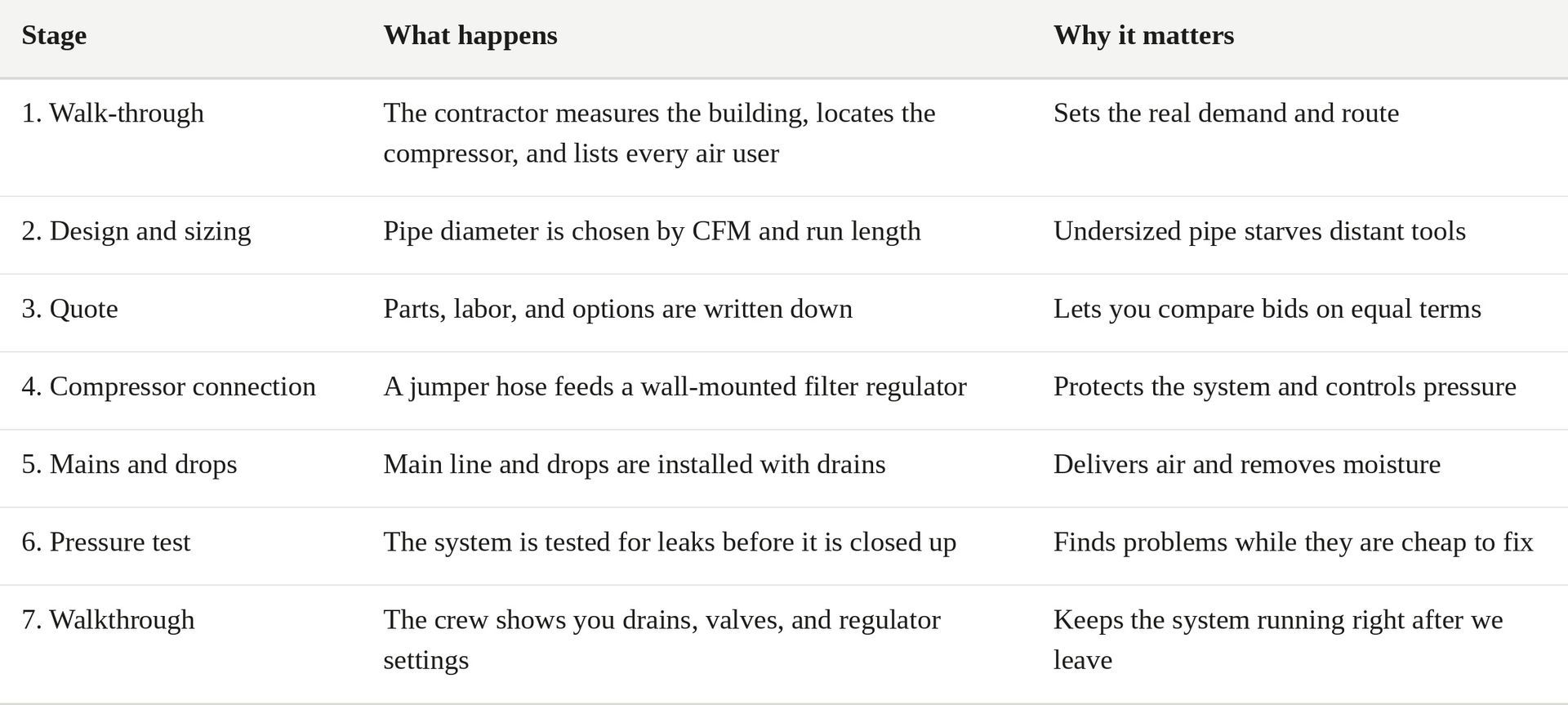
A professional compressed air piping installation in Virginia has seven stages: a site walk-through, system design and pipe sizing, a written quote, the compressor connection, the mains and drops, a pressure test, and a final walkthrough. The order matters, because most installation problems trace back to a skipped step. This guide explains each stage so you know what to expect and what to ask any contractor.
What Does a Compressed Air Piping Installation Involve?
How Does a Contractor Size and Design the System?
Sizing is based on flow, not on the size of the port on your compressor. RapidAir explains that pipe diameter depends on the CFM your tools need and the length of the run. Longer runs need larger pipe. A small outlet on the compressor tank does not limit the pipe size, because the air travels only a short distance before it enters the larger system.
One mistake we correct often is shrinking the pipe toward the end of a run. RapidAir states that stepping down to a smaller diameter at the end of a line reduces flow. A good design keeps the diameter consistent, adds a loop where the building allows it, and plans extra drops for the future. Our systems are designed to be expandable, so adding a bay later means adding a drop, not replacing the main.
How Does the Compressor Connect to the Piping?
A typical connection starts at the compressor with a flexible jumper hose, which feeds a filter regulator mounted on the wall. The piping begins on the output side of the regulator.
The regulator is a key part. RapidAir recommends setting it between 90 and 110 psi, even when your compressor cycles at a much higher pressure. That keeps pipe pressure under the system’s rating and protects tools, since most air tools are rated for a maximum of about 120 psi.
Placement matters as well. RapidAir notes that air cools as it moves away from the compressor, which turns water vapor into liquid that is easier to filter. The filter regulator works best about 20 feet from the compressor, though a smaller shop can place it closer and still get acceptable results.
Why Does Installation Quality Matter for Energy and Reliability?
Leaks are the most common hidden cost in compressed air. The U.S. Department of Energy states that leaks can waste 20 to 30 percent of a compressor’s output in a poorly maintained system, and that a proactive repair program can bring that below 10 percent. That is energy you pay for and never use.
Most leaks happen at fittings and connections. That is why we treat the pressure test as a required step, not an optional one. RapidAir says pressure testing is essential whenever you will not have access to the fittings afterward, including in-wall and buried systems. We also compare our work against your compressor’s health, since a worn compressor wastes energy no matter how good the piping is. Our commercial air compressor repair service covers units from 5 to 600 HP.
How Long Does an Installation Take?
It depends on footage, the number of drops, the building construction, and whether the lines run on the surface, in walls, or underground. Access also matters: a project in an occupied shop that must keep running takes more planning than an empty building.
Material choice changes the labor. RapidAir’s own published comparison lists about 1.2 labor hours per 100 feet for aluminum pipe, against about 8 hours for black iron. That figure comes from a company that sells aluminum, so treat it as a manufacturer claim, and ask any contractor for a schedule based on your building. We give you one in the quote.
How Do You Choose a Compressed Air Contractor in Virginia?
Check these items when selecting a contractor in VA:
- A valid Virginia license. You can verify any contractor through the license lookup at the Virginia Department of Professional and Occupational Regulation (DPOR). Class A is the highest license tier.
- In-house design. Ask who sizes the pipe and who draws the layout.
- Written scope. The quote should list parts, drops, drains, the regulator, and the pressure test.
- After-hours support. Air failures do not wait for business hours.
- Compressor knowledge. The person who installs your piping should understand the machine feeding it.
- Local presence. Many regional suppliers serve the Valley from distant branches. A local installer can return quickly.
VA Commercial Repair Solutions is SWAM certified and holds Virginia Class A license 2705180394. Since 2015, we have installed RapidAir systems, and we report no call-backs on those systems for any reason, including leaks. Our only return trips have been to add on to systems we installed.
What Should You Have Ready Before You Call?
A quote goes faster with a few details:
- Your building’s square footage and ceiling height
- Your compressor’s horsepower or CFM rating
- The number and location of air drops you need
- Photos of any current piping
- Any plans for expansion over the next few years
Start with our RapidAir installation service page, see completed jobs in the installation gallery, or request a free quote. We serve Fishersville, Staunton, Waynesboro, Harrisonburg, Charlottesville, Lexington, and a 250-mile radius.
Frequently Asked Questions
What are the steps in a compressed air piping installation?
The steps are a site walk-through, design and pipe sizing, a written quote, the compressor connection with a filter regulator, installation of the mains and drops, a pressure test, and a final walkthrough. VA Commercial Repair Solutions follows this process on every Virginia project.
What pressure should a compressed air system run at?
RapidAir recommends setting the regulator between 90 and 110 psi. Most air tools are rated for a maximum of about 120 psi, so staying below that protects both tools and piping.
Does a compressed air system need a pressure test?
Yes, especially when the fittings will be hidden. RapidAir says pressure testing is essential for in-wall and underground systems. We test every installation before we finish.
How much energy do compressed air leaks waste?
The U.S. Department of Energy says leaks can waste 20 to 30 percent of a compressor’s output in a poorly maintained system, and that a proactive program can cut that below 10 percent.
How do I verify a Virginia contractor’s license?
Use the license lookup at the Virginia Department of Professional and Occupational Regulation (DPOR). Class A is the highest tier. VA Commercial Repair Solutions holds Class A license 2705180394.
Who installs compressed air piping near Staunton, Harrisonburg, or Charlottesville?
VA Commercial Repair Solutions, based in Fishersville, Virginia, is the local RapidAir factory representative and installer. A live person answers 24/7 at (540) 457-4822 or (866) 729-2215.